


ESG & Green Economy Fundamentals for Malaysian Organizations
Fundamental
9:00am - 5:00pm (1-Day)
Pre-requisite: No

INTRODUCTION
“ESG is not merely about compliance; it is a discipline of risk management, trust, and organizational sustainability.”
This is a practical, face-to-face training program designed to equip participants with a clear understanding of Environmental, Social, and Governance (ESG) principles and how to translate ESG into tangible actions in the workplace.
The course guides teams in identifying organizational ESG priorities, designing realistic initiatives, and establishing ESG readiness monitoring mechanisms (actions, indicators, and evidence) to support continuous improvement and future reporting preparedness.
The training approach is straightforward, non-technical, and focused on deliverable outcomes that departments can immediately apply upon completion of the program.
WHO SHOULD ATTEND?
Management / Heads of Department
Strategy or CSR teams
Compliance and Governance functions
ESG champions or project teams supporting ESG initiative
COURSE OBJECTIVE
To equip participants with a clear and practical understanding of ESG principles and their distinction from CSR and sustainability, and to enable them to identify relevant ESG risks and opportunities, prioritize key ESG issues using a simplified materiality approach, design measurable ESG initiatives, and establish practical monitoring mechanisms to support organizational ESG readiness and continuous improvement.


LEARNING OUTCOME
Understand the ESG (Environmental, Social, Governance) framework and distinguish ESG from CSR and sustainability.
Identify ESG-related risks and opportunities that are relevant to the organization and departmental operational processes.
Determine ESG priorities using a simplified materiality approach to focus on what matters most.
Develop practical ESG initiatives with clearly defined persons-in-charge (PIC), timelines, and measurable outcomes.
Establish ESG readiness monitoring methods through a Readiness Tracker and Evidence Checklist, including the basics of a Risk Register and mitigation actions.
By the end of the course, participants will :
TRAINING METHODOLOGY
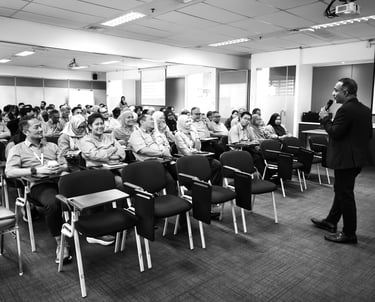
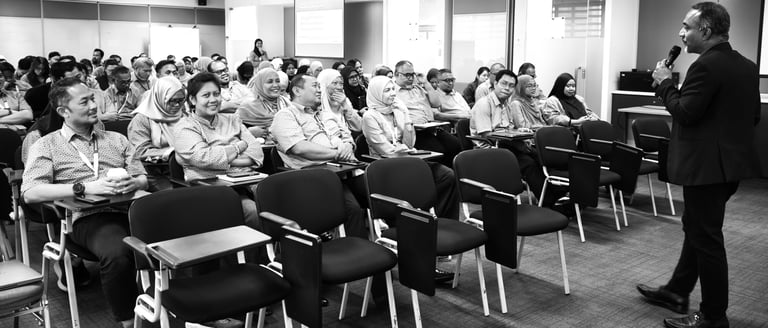
Face-to-face training conducted through interactive, hands-on workshops
Group discussions based on organizational scenarios and context
Activities mapping departmental work processes to ESG requirements (department-level mapping)
Guided workshops to produce concrete deliverables (trackers, checklists, roadmaps, risk registers)
Real-world simulations and group presentations with facilitator feedback
COURSE CONTENT
Module 1: ESG Fundamentals (What ESG Really Is)
Objective: To provide participants with a clear and practical understanding of ESG fundamentals and how ESG differs from CSR and sustainability, while highlighting why ESG matters to organizational performance and risk management.
Simple explanation of ESG: Environmental, Social, Governance
ESG vs CSR vs Sustainability: key differences
Why ESG matters: risk, trust, compliance, cost, and competitiveness
Characteristics of “good ESG” (beyond a tick-box exercise)
Module 2: ESG in Daily Operations (Where ESG “Lives”)
Objective: To help participants recognize how ESG manifests within daily operational processes and identify ESG-related risks across Environmental, Social, and Governance dimensions.
Environmental examples: energy, waste, emissions, resource efficiency
Social examples: employee well-being, safety, customer responsibility, community impact
Governance examples: integrity, controls, transparency, ethical procurement
Activity: mapping ESG topics to organizational work processes
Examples of ESG risks by E/S/G category
Risk vs impact vs likelihood (simplified)
Activity: identify the Top 3 ESG risks for each group (E/S/G)
Module 3: ESG Prioritization (Simplified Materiality Approach)
Objective: To enable participants to prioritize ESG issues using a practical and simplified materiality approach that focuses on what matters most to the organization and its stakeholders.
Meaning of “material”: impact and stakeholder relevance
Stakeholder mapping: who cares about what and why
Simple scoring method (high / medium / low)
Workshop: develop an ESG priority list at organizational or departmental level
Module 4: ESG Initiatives & Quick Wins (Action Planning)
Objective: To guide participants in translating ESG priorities into practical, measurable initiatives, including quick wins and longer-term actions, with clear ownership and timelines.
Translating priorities into initiatives (quick wins and long-term initiatives)
Assigning persons-in-charge (PIC), timelines, and resource reality checks
Defining measurable outcomes (KPIs or simple indicators)
Workshop: design 3–5 ESG initiatives with clear outcomes and owners
Module 5: ESG Readiness Monitoring & Evidence (Practical & Traceable)
Objective: To equip participants with practical tools to monitor ESG readiness, track progress, and compile evidence to support internal reviews and future reporting.
What to track: actions, indicators, evidence, approvals
Building an ESG Readiness Tracker (simple spreadsheet format)
Evidence checklist: what qualifies as evidence and where it is stored
Workshop: build a tracker and evidence checklist for selected initiatives
Additional: develop an ESG tracker, starter ESG Risk Register, and initial mitigation actions with assigned PICs


ESG, Sustainability & Green Economy

ESG & Green Economy Fundamentals for Malaysian Organizations



14th January 2026
9:00am - 5:00pm
1-Day
SH insights Services (SA0632854-A)
Level 41, Vista Tower, The Intermark
348, Jalan Tun Razak
50400 Kuala Lumpur
Malaysia

Copyright © 2026 SH-insights. All rights reserved.